- Sinamangal Kathmandu
Nepal -
Sun - Friday 8.00 - 18.00.
Saturday CLOSED
IUI Procedure Step by Step: Follicle Monitoring, Trigger Timing and Sperm Preparation
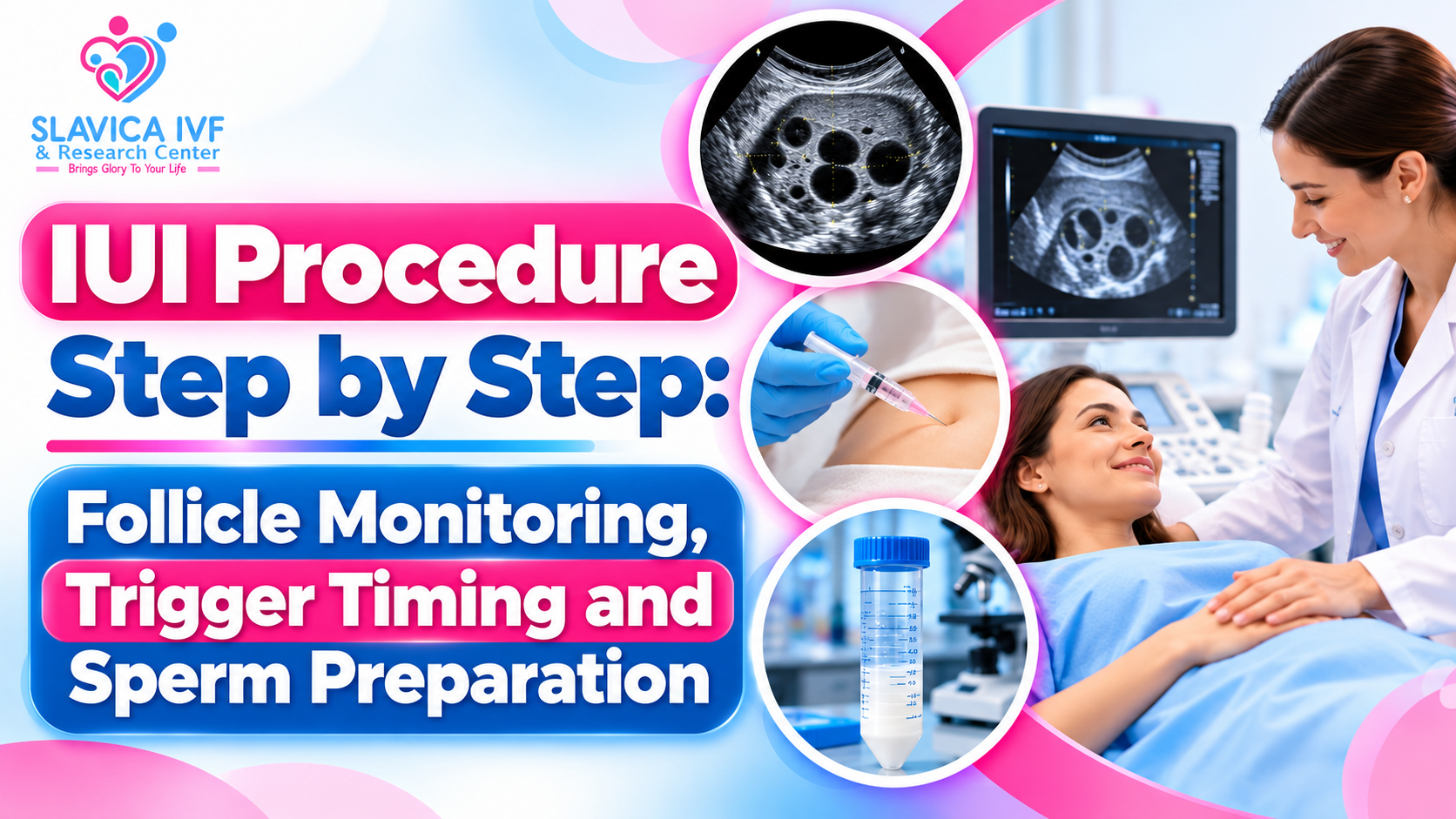
IUI Procedure Step by Step: Follicle Monitoring, Trigger Timing and Sperm Preparation
An IUI procedure is much more than the few minutes required to place prepared sperm into the uterus. A complete intrauterine insemination cycle may include fertility assessment, monitoring of follicle development, identifying or triggering ovulation, preparing a semen sample in the laboratory and timing insemination so that viable sperm are present around the period when an egg is expected to be released.
The exact protocol is not identical for every patient. Some people undergo IUI during a natural menstrual cycle, while others receive medication to support or stimulate ovulation. Monitoring frequency, medication and insemination timing therefore depend on the clinical situation.
The UK Human Fertilisation and Embryology Authority describes IUI as a treatment in which selected sperm are placed directly into the uterus, while the NHS notes that the procedure is timed around ovulation.
At Slavica IVF & Research Center in Kathmandu, IUI, follicular monitoring, ovulation induction and semen analysis are listed among the centre’s fertility services.
What happens during an IUI cycle?
A typical IUI treatment pathway can be understood as a sequence:
- Assess whether IUI is appropriate.
- Decide whether the cycle will be natural or medically stimulated.
- Monitor follicle growth and signs of ovulation.
- Identify spontaneous ovulation or use a trigger injection when clinically appropriate.
- Collect or prepare the semen sample.
- Process the sample in the laboratory to obtain a suitable sperm preparation.
- Place the prepared sperm into the uterus using a thin catheter.
- Follow the clinic’s instructions and perform a pregnancy test at the recommended time.
The sequence is straightforward, but decisions within each stage can differ substantially between patients.
Step 1: Confirm whether IUI is an appropriate treatment
Before beginning an IUI cycle, the fertility team generally needs to understand why pregnancy has not occurred and whether sperm and egg have a reasonable opportunity to meet after insemination.
That may involve assessment of ovulation, semen quality and the fallopian tubes.
The NHS states that fertility assessment before IUI includes checking that the fallopian tubes are open and healthy. If partner sperm will be used, male fertility testing is also normally required.
This matters because IUI does not bypass the fallopian tubes. Fertilisation still normally occurs inside the reproductive tract.
IUI may therefore be unsuitable or have a low probability of success in some situations, including significant tubal blockage or severe sperm-factor problems. HFEA also advises that IUI should not simply be regarded as a less expensive substitute for IVF when significant fertility problems are present.
A semen analysis is one part of this assessment. However, one sperm value should not be treated as a stand-alone decision about treatment. The AUA/ASRM male-infertility guideline notes that repeatedly low total motile sperm counts can reduce the likelihood of IUI success, particularly when very few motile sperm remain after processing.
Step 2: Decide between a natural and stimulated IUI cycle
Not every IUI cycle requires fertility medication.
In a natural-cycle IUI, clinicians monitor the person’s own menstrual cycle and attempt to identify the period around spontaneous ovulation.
In a stimulated cycle, medication is used to influence follicle development or ovulation. The objective and medication depend on the reason treatment is being used.
HFEA explains that IUI may be carried out with fertility medication or as part of a normal menstrual cycle.
This distinction is important because stimulation changes both monitoring requirements and risk.
When fertility medications encourage more follicles to develop, the possibility of releasing more than one egg can increase. That is one reason ultrasound monitoring can become a safety measure rather than merely a method of selecting an appointment date.
Slavica lists ovulation induction as a fertility service and describes it as using medication to stimulate the development and release of mature eggs.
Medication should be prescribed and monitored by the treating clinician. Patients should not attempt to reproduce another person’s IUI medication schedule or trigger timing.
Step 3: Monitor follicle development
A follicle is a fluid-filled structure within the ovary that contains a developing egg.
During an IUI cycle, ultrasound may be used to follow follicle development and help the treatment team understand how the ovaries are responding.
Slavica’s follicular monitoring service describes monitoring as tracking ovarian follicle growth and ovulation timing, potentially using ultrasound and hormone measurements.
The purpose is not simply to record a follicle measurement.
Monitoring may help clinicians answer questions such as:
- Is a follicle developing?
- Is the ovarian response appropriate for the treatment plan?
- Is ovulation approaching?
- Should another scan or hormone assessment be performed?
- Is a trigger injection appropriate?
- Have too many follicles developed for the planned treatment to proceed safely?
The last question is particularly important in stimulated cycles.
HFEA advises that patients receiving fertility drugs should have scans to monitor how many follicles are developing. If too many follicles develop, treatment may need to be stopped because of the increased risk of a multiple pregnancy.
For this reason, “more follicles” is not automatically better.
Step 4: Identify ovulation or decide on trigger timing
IUI works by placing prepared sperm into the uterus around the period of ovulation.
There are different ways to determine that timing.
In a natural cycle, the clinic may monitor biological signs associated with impending ovulation, including an LH surge detected through appropriate testing.
In another protocol, a clinician may prescribe an injection—commonly involving hCG—to help coordinate final egg maturation and ovulation.
The NHS explains that patients who require help with ovulation may receive medication, undergo ultrasound monitoring and then receive a hormone injection when the egg is considered ready.
One common misunderstanding is that there is a single universally correct number of hours between a trigger injection and insemination.
Clinical evidence is more nuanced.
The American Society for Reproductive Medicine reviewed studies evaluating IUI timing relative to hCG administration for unexplained infertility. Its guideline recommends that a single IUI in ovarian-stimulation/IUI treatment can be performed within a window of 0–36 hours relative to the hCG injection.
That does not mean patients should choose their own time within that range.
The treating clinic makes timing decisions based on its protocol and the individual’s cycle, follicle development, medication and other clinical information.
The practical question for a patient is therefore not:
“What is the universal perfect hour for IUI?”
It is:
“How is my clinic determining the correct timing for this particular cycle?”
Step 5: Collect the semen sample
When partner sperm is being used, a fresh semen sample is often produced on or close to the day of insemination according to the laboratory’s instructions.
The NHS notes that a partner providing sperm is generally asked to produce a sample at the fertility clinic, usually on the day of the IUI procedure.
The precise collection instructions matter because sample quality can be influenced by collection conditions.
Patients should follow their own laboratory’s guidance about abstinence, collection container, sample completeness and delivery rather than applying instructions taken from another clinic or an internet article.
If frozen donor sperm is used, the handling and preparation process is different and should follow the fertility centre’s laboratory, screening and consent procedures.
Step 6: Prepare the sperm for insemination
Raw semen is not simply drawn into a syringe and placed into the uterus.
It first undergoes laboratory preparation.
The purpose is to create a sperm preparation suitable for intrauterine use while concentrating or selecting motile sperm and separating them from other components of the ejaculate.
HFEA describes IUI as involving separation of better-quality sperm before those sperm are introduced into the uterus.
The World Health Organization’s sixth-edition laboratory manual provides standardized procedures for examining and processing human semen and contains dedicated sperm-preparation methods for clinical laboratory use.
The phrase “sperm washing” is commonly used to describe this stage, although laboratories may use different preparation techniques depending on the sample and their validated laboratory protocols.
Sperm preparation does not repair every sperm abnormality and does not guarantee fertilisation or pregnancy.
Instead, it aims to produce a clinically appropriate sample for insemination.
The number of motile sperm remaining after preparation can sometimes influence whether IUI remains a reasonable treatment option. AUA/ASRM guidance states that couples may be counselled that IUI pregnancy rates may be lower when repeated semen assessments demonstrate a low total motile sperm count; the guideline particularly notes reduced chances when the post-processing total motile sperm count is below about 5 million.
That number should not be treated as a patient-controlled pass/fail threshold. Treatment decisions still require the complete fertility picture.
Step 7: Perform the intrauterine insemination
Once the sperm preparation is ready and the timing has been determined, insemination itself is usually brief.
According to the NHS, the clinician typically inserts a speculum into the vagina, guides a thin flexible catheter through the cervix and passes the prepared sperm sample through the catheter into the uterus. The catheter and speculum are then removed.
No egg retrieval or embryo transfer is involved.
That distinction separates IUI from IVF.
In IUI, fertilisation—if it occurs—still takes place inside the body. In IVF, eggs are collected and fertilised in a laboratory before an embryo is transferred to the uterus.
The NHS states that the insemination itself generally takes no more than about 10 minutes. It is not normally painful, although some people experience discomfort or short-lived cramping.
Step 8: What happens after IUI?
Most patients can leave after a short period and follow the clinic’s normal post-procedure advice.
The important next milestone is the pregnancy test.
Testing too early can create misleading results, particularly when fertility medication has been used. HFEA therefore advises following the date provided by the treatment clinic rather than testing prematurely.
A negative result does not automatically mean another identical cycle should begin.
The clinician may review:
- ovarian response
- whether ovulation and insemination were appropriately coordinated
- the semen and post-processing findings
- any difficulty with the procedure
- age and ovarian factors
- how many IUI cycles have already been attempted
- whether continuing IUI or changing strategy is reasonable.
For unexplained infertility specifically, ASRM recommends a limited course typically three or four cycles of ovarian stimulation with oral medication plus IUI before moving to IVF when treatment remains unsuccessful. That recommendation applies to a defined clinical population and should not be generalized to every person undergoing IUI.
Can an IUI cycle be cancelled?
Yes.
A cycle may occasionally need to be changed or stopped for safety or clinical reasons.
One important example is excessive follicular development following ovarian stimulation.
HFEA specifically warns that too many developing follicles can increase the likelihood of multiple pregnancy and that treatment may need to be stopped.
A clinic may also reconsider a cycle because of unexpected ovarian response, ovulation occurring at an unplanned time, a problem obtaining or preparing an adequate semen sample, illness or another clinical concern.
Slavica-specific cancellation criteria should be confirmed by its fertility team before publication rather than inferred from another clinic’s protocol.
What are the risks of IUI?
IUI is generally considered a safe fertility procedure, but “safe” does not mean risk-free.
The NHS identifies a small risk of infection following IUI. When fertility medication is used, additional concerns can include multiple pregnancy, ectopic pregnancy and ovarian hyperstimulation syndrome, or OHSS.
HFEA similarly identifies multiple pregnancy as one of the most important risks associated with fertility treatment and notes that severe reactions to fertility medication can occur in rare cases.
Patients receiving ovarian-stimulation medicines should understand the warning symptoms given by their own fertility clinic and know whom to contact if they develop significant pain, abdominal swelling, breathing difficulty, faintness or other concerning symptoms.
Who may not benefit from IUI?
IUI is not appropriate for every fertility problem.
For example, significant fallopian-tube obstruction can prevent sperm and egg from meeting even when sperm are successfully placed inside the uterus.
Severe male-factor infertility may also make IUI much less effective when too few motile sperm remain available after processing.
HFEA additionally notes that people with significant fertility problems may be advised to consider treatments other than IUI depending on their diagnosis, age and reproductive circumstances.
The decision should therefore be based on fertility assessment rather than simply choosing the least invasive treatment first.
IUI procedure in Kathmandu: questions worth asking your clinic
If you are considering IUI in Kathmandu, ask the clinic to explain its actual protocol rather than relying on a generic online timeline.
Useful questions include:
- Why is IUI appropriate for our fertility situation?
- Do we need a natural or stimulated cycle?
- How will follicle development be monitored?
- What would cause the cycle to be cancelled?
- How will you determine whether and when a trigger injection is needed?
- How will the semen sample be collected and prepared?
- What will you assess after sperm preparation?
- When will insemination take place?
- Which symptoms should prompt us to contact the clinic?
- When should we perform the pregnancy test?
- How many cycles would you normally consider before reassessing the treatment plan?
- What does the complete treatment estimate include?
Slavica IVF & Research Center lists IUI, follicular monitoring, ovulation induction and semen analysis among its fertility services in Sinamangal, Kathmandu. Patients who are considering treatment can begin with a fertility assessment to determine whether IUI is appropriate for their individual situation.
For treatment-cost considerations, see Slavica’s guide to IUI cost in Nepal, which explains why monitoring, testing, medication and sperm preparation can affect the complete treatment expense.
Key takeaway
The IUI procedure itself is short. The clinically important work happens around it.
A well-managed IUI cycle involves determining whether IUI is suitable, monitoring ovulation or ovarian response when needed, selecting appropriate timing, preparing sperm correctly and performing insemination safely.
There is no single IUI protocol that applies to every patient.
If you are considering IUI treatment in Kathmandu, the useful next step is a fertility assessment that explains why IUI is being recommended and how your own cycle will be monitored and timed.
Medical review required before publication: qualified fertility specialist/reproductive-medicine reviewer to confirm clinical wording and any Slavica-specific protocol details.