- Sinamangal Kathmandu
Nepal -
Sun - Friday 8.00 - 18.00.
Saturday CLOSED
IVF Process Step-by-Step: What Couples Should Expect
IVF Process Step-by-Step: What Couples Should Expect
The IVF Process (in vitro fertilization) can feel overwhelming at first appointments, tests, injections, lab updates, and a lot of waiting. But when you break it down into clear steps, it becomes more manageable and predictable. This guide explains the IVF Process from the first consultation to the pregnancy test, including realistic timelines, what each partner can expect, common side effects, and the key decisions you may face especially for couples planning ivf in Nepal, including ivf in Kathmandu, through a reputable ivf clinic in Nepal.
Infertility is also more common than many people realize. The World Health Organization estimates that about 1 in 6 people worldwide experience infertility in their lifetime.
Medical note: This article is educational and does not replace medical advice. Your exact IVF Process may differ based on age, diagnosis, and clinic protocol.
IVF Process overview: what it is and who it helps
The IVF Process is a fertility treatment where eggs are collected from the ovaries, fertilized with sperm in a laboratory, and then an embryo is transferred to the uterus. IVF can be recommended for several reasons, including:
- blocked or damaged fallopian tubes
- ovulation disorders (including PCOS)
- endometriosis
- male-factor infertility (low count, motility, or morphology issues)
- unexplained infertility
- fertility preservation (in some situations)
WHO describes infertility as the failure to achieve pregnancy after 12 months or more of regular unprotected intercourse and notes that causes can involve female, male, or unexplained factors.
Why “couple-based” evaluation matters
Infertility often isn’t due to a single cause. In a Nepal-based tertiary-care study (Journal of Nepal Medical Association), semen abnormalities were found in 34.12% of men in the clinic sample, and female factors like tubal block were also common.
That’s why most IVF clinics evaluate both partners early in the IVF Process.
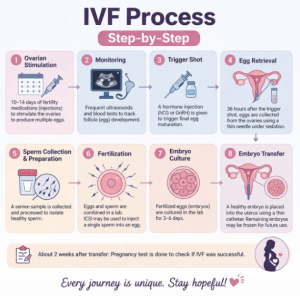
IVF Process step-by-step timeline
One reason people feel anxious about IVF is not knowing how long it takes. A single IVF cycle (from day 1 of period to pregnancy test) often spans about 4–6 weeks, though timing varies.
Table: Typical IVF Process timeline (example)
| Phase | Common time frame | What happens |
| Initial consult + testing | 1–4 weeks (sometimes longer) | Blood tests, ultrasound, semen analysis, planning |
| Ovarian stimulation | ~8–12 days | Daily injections; ultrasounds + hormone blood tests |
| Trigger shot | 1 day | Final egg maturation injection |
| Egg retrieval | 34–36 hours after trigger | Short procedure with anesthesia/sedation |
| Fertilization + embryo culture | Day 0–5/6 after retrieval | IVF or ICSI; embryo growth to blastocyst stage |
| Embryo transfer (fresh or frozen) | Fresh: day 3–5; Frozen: later cycle | Embryo placed into uterus |
| Pregnancy test | ~9–14 days after transfer | Blood test (hCG) + follow-up plan |
SART (Society for Assisted Reproductive Technology) outlines key steps similarly: stimulation, monitoring, trigger, egg retrieval, fertilization (standard IVF or ICSI), and subsequent transfer planning.
Before you start: tests and preparation
IVF Process Step 1: First consultation and medical history
Expect questions about:
- how long you’ve been trying
- menstrual cycle patterns and previous pregnancies
- past surgeries, infections, or known conditions (thyroid disease, PCOS, etc.)
- medications, smoking/alcohol, and lifestyle
- family history (genetic conditions)
IVF Process Step 2: Baseline fertility testing (both partners)
Common tests for the female partner
- Ultrasound (baseline scan): looks at ovaries and uterus
- Hormone tests: may include AMH, FSH, LH, estradiol, TSH, prolactin (varies)
- Infection screening (clinic-dependent)
- Uterine cavity assessment (selected cases)
- Tubal assessment (sometimes done earlier in fertility workup)
Common tests for the male partner
- Semen analysis (count, motility, morphology)
- Infection screening (clinic-dependent)
- Sometimes additional evaluation depending on results
Table: What tests are for (simple guide)
| Test | What it helps estimate | Why it matters in the IVF Process |
| AMH / ovarian reserve markers | Approx. egg supply | Helps choose medication dose |
| Ultrasound (AFC) | Follicle count and anatomy | Predicts response to stimulation |
| TSH / prolactin | Hormone balance | Can affect ovulation and implantation |
| Semen analysis | Male-factor issues | Helps decide IVF vs ICSI |
| Uterus/cavity check (if needed) | Polyps, fibroids, shape | Supports transfer planning |
During the cycle: injections, monitoring, and procedures
IVF Process Step 3: Ovarian stimulation (injections)
The IVF Process usually uses hormonal injections (gonadotropins) to mature multiple follicles in one cycle. SART describes this stimulation phase and notes that clinics adjust medication based on monitoring results.
What couples should expect
- Daily injections for about 8–12 days (varies)
- Mild-to-moderate bloating, pelvic heaviness, fatigue, mood changes (not everyone)
- Frequent monitoring appointments (ultrasound + blood tests)
IVF Process Step 4: Monitoring (ultrasound + blood tests)
Monitoring checks:
- follicle size and growth
- hormone levels (often estradiol)
- risk of over-response (to prevent complications)
SART specifically notes monitoring follicle development using ultrasound and serum estradiol tests.
IVF Process Step 5: “Trigger shot” for final egg maturation
When follicles reach target size, a “trigger” injection is given to finalize egg maturation, and egg retrieval is scheduled ~34–36 hours later.
IVF Process Step 6: Egg retrieval (oocyte retrieval)
Egg retrieval is typically a short, ultrasound-guided procedure under sedation/anesthesia. SART describes retrieval as transvaginal ultrasound-guided collection of eggs .
What to expect after retrieval
- Rest the same day
- Cramping or spotting for a short period
- Avoid strenuous exercise briefly (your clinic will advise)
IVF Process Step 7: Sperm sample and fertilization (IVF or ICSI)
On retrieval day (or via pre-frozen sample), sperm is prepared in the lab.
Two common fertilization approaches
- Conventional IVF: eggs and sperm incubated together
- ICSI: a single sperm is injected into an egg (often used for male-factor or specific indications)
Globally, ICSI is widely used ESHRE’s ART factsheet estimates ICSI accounts for ~73% of treatments worldwide.
IVF Process Step 8: Embryo culture (day 1 to day 5/6)
Embryologists monitor embryo development. Many clinics aim for transfer or freezing at the blastocyst stage (day 5/6), depending on embryo development and patient factors.
IVF Process Step 9: Fresh vs frozen embryo transfer (FET)
Your team may recommend:
- Fresh transfer (same cycle) if hormones and uterine lining are suitable
- Frozen embryo transfer (FET) if freezing is safer or better timed (common in many settings)
Embryo transfer: what couples should expect
IVF Process Step 10: Embryo transfer day
Embryo transfer is usually a simple procedure (often no anesthesia). The embryo is placed into the uterus using a thin catheter.
ASRM provides clinical guidance on embryo transfer technique and emphasizes the importance of careful transfer practices for outcomes.
What it feels like
- Often similar to a gynecologic exam
- Mild cramping possible
- Many people return to routine activities the same day (clinic advice varies)
How many embryos are transferred?
Modern IVF increasingly favors single embryo transfer to reduce twins/triplets and related risks.
- In the UK, HFEA reports multiple births from IVF fell to 3.4% in 2023, one of the lowest rates globally.
- In the US, SART reported 96.74% singleton births from IVF in 2023.
After transfer: the two-week wait and next steps
IVF Process Step 11: Luteal support (progesterone support)
Many IVF cycles include progesterone after retrieval/transfer to support the uterine lining. Medical literature notes that controlled ovarian stimulation can affect luteal-phase hormones, and luteal support is commonly used in IVF practice.
IVF Process Step 12: Pregnancy test (beta hCG)
A blood test is typically done about 9–14 days after embryo transfer (timing varies).
If positive
- repeat testing may be scheduled
- early ultrasound is planned later to confirm location and viability
If negative
- follow-up appointment reviews what happened and next options (another transfer, another retrieval, protocol changes, or additional evaluation)
IVF success rates: what the numbers really mean
It’s normal to search for “IVF success rate,” especially if you’re considering ivf in nepal or ivf in kathmandu. But success rates depend on many factors, especially age and diagnosis.
Key global context (how common IVF is)
ESHRE’s ART factsheet reports that registry data suggest around 4 million ART cycles may occur each year worldwide, with about 1,000,000 babies born (estimates based on reporting coverage).
In the US, SART reported 432,641 IVF cycles in 2023 and 95,860 babies born via IVF (about 2.6% of births).
Age matters (a lot)
HFEA’s UK national data (2023) shows clear age differences:
- Fresh embryo transfer birth rate (own eggs): 25% overall
- Ages 18–34: 35%
- Ages 43–44: 5%
Table: Example IVF outcomes snapshot (UK, 2023)
| Outcome measure | Overall | Younger group | Older group |
| Fresh transfer birth rate (own eggs) | 25% | 35% (18–34) | 5% (43–44) |
| Frozen transfer pregnancy rate | 39% | (varies by egg age) | (varies by egg age) |
| Frozen transfer birth rate | 33% | (varies by egg age) | (varies by egg age) |
Source: HFEA “Fertility treatment 2023: trends and figures.”
How to interpret success rates (avoid common misunderstandings)
When comparing an ivf clinic in nepal or anywhere else, ask:
- Is the rate per transfer, per cycle started, or cumulative (including frozen transfers from one retrieval)?
- Are donor eggs included or excluded?
- Are they reporting outcomes by age group?
Also note: ESHRE reports that in Europe (2020) the pregnancy rate per embryo transfer was around 33% after IVF/ICSI and about 35.9% after frozen embryo transfer (FET), with higher rates in younger patients.
Risks, side effects, and safety
Most people complete IVF safely, but every medical procedure has risks.
Common short-term side effects
- bloating and pelvic heaviness during stimulation
- injection-site soreness
- mood changes and fatigue
- cramping/spotting after retrieval or transfer
Ovarian Hyperstimulation Syndrome (OHSS)
OHSS is a potential complication of ovarian stimulation (more likely with high response). ASRM provides clinical guidance on prevention and management of moderate/severe OHSS, including risk reduction strategies used in modern IVF protocols.
Seek urgent care if severe abdominal pain, shortness of breath, rapid swelling, or severe vomiting occurs (your clinic will provide warning signs).
Multiple pregnancy risk
This has decreased with single embryo transfer policies and improved freezing strategies. HFEA notes the multiple birth rate fell to 3.4% in 2023 in the UK.
IVF Process in Nepal: planning and practical considerations
Couples researching in Nepal often have practical questions that don’t get answered in short clinic brochures: scheduling, travel, time off work, and realistic preparation.
IVF in Kathmandu: scheduling your month
If you’re doing ivf in kathmandu, plan for:
- multiple monitoring visits over 1–2 weeks
- a retrieval day requiring rest and transport support
- flexibility in work schedules (especially near trigger/retrieval)
What to check with an IVF clinic in Nepal
To keep decisions evidence-based (not marketing-based), ask these quality questions:
- Do you provide outcomes by age group and diagnosis?
- Do you encourage single embryo transfer when appropriate?
- What lab standards and embryo culture practices do you follow?
- How do you reduce OHSS risk?
- Is counseling available for stress and decision-making?
A Nepal context note (fertility trends)
Nepal’s total fertility rate was 2.1 children per woman in the Nepal DHS 2022 key indicators report.
This doesn’t directly measure infertility, but it reflects broader demographic change and why fertility care conversations have become more visible.
Practical checklist: what couples can do to feel more prepared
Before the IVF Process begins
- Write down your questions (medications, timelines, risks, costs)
- Gather past medical records and test results
- Review work/travel schedule for monitoring days
- Discuss emotional support plans (partner, family, counselor)
During stimulation
- Set reminders for injection times
- Keep a simple symptom log (bloating, pain, mood, sleep)
- Hydrate and avoid intense exercise if advised
- Ask exactly when to call the clinic (red flags)
After embryo transfer
- Follow medication instructions carefully
- Avoid “testing too early” with home tests unless your clinician advises
- Plan distractions for the waiting period (gentle routine, sleep, support)
FAQs
What is the IVF Process (in simple words)?
The IVF Process is a fertility treatment where eggs are collected, fertilized in a lab, and an embryo is transferred to the uterus to try to achieve pregnancy.
How long does the IVF Process take?
Many IVF cycles take about 4–6 weeks from period start to pregnancy test, but pre-cycle testing and scheduling can add time.
Is the IVF Process painful?
Many people describe injections as uncomfortable rather than painful. Egg retrieval is usually done with sedation/anesthesia, and transfer is typically mild. Experiences vary.
Why do some couples need ICSI during the IVF Process?
ICSI is often used when sperm parameters are low, fertilization risk is higher, or there are specific clinical reasons. ESHRE reports ICSI is used in a large share of treatments globally (~73%).
What affects IVF success the most?
Age, egg/embryo quality, sperm quality, uterine factors, diagnosis (tubal issues, endometriosis, PCOS, male-factor), and how embryos are transferred. National data show success declines with age.
If we’re considering ivf in nepal or ivf in kathmandu, what should we prioritize?
Choose a clinic based on transparent outcomes by age group, safe practices (OHSS prevention, single embryo transfer where appropriate), good lab standards, and strong follow-up care more than advertising claims.