- Sinamangal Kathmandu
Nepal -
Sun - Friday 8.00 - 18.00.
Saturday CLOSED

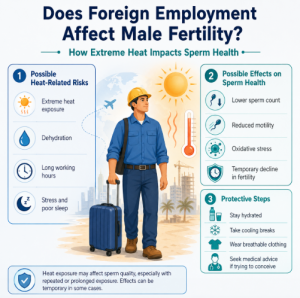
Does Foreign Employment Affect Male Fertility? How Extreme Heat Impacts Sperm Health
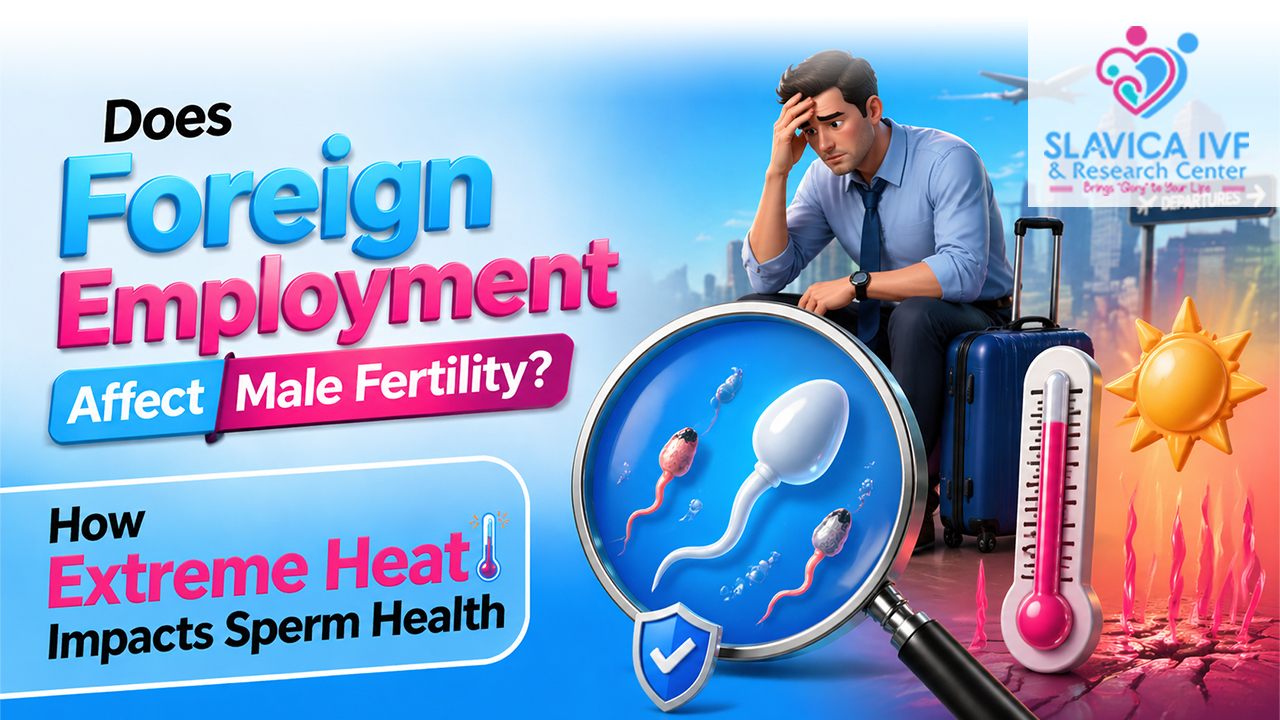
Does Foreign Employment Affect Male Fertility? How Extreme Heat Impacts Sperm Health
Male fertility can be affected by many factors, including heat exposure, smoking, stress, infections, varicocele, lifestyle, hormones, and medical conditions. For many Nepali men working abroad in hot climates, especially in construction, factories, kitchens, driving, security, and outdoor labor, prolonged heat exposure may affect sperm health over time.
Extreme heat does not make every man infertile. But repeated exposure to high temperatures can reduce sperm production, sperm movement, and sperm quality in some men.
If a couple has been trying to conceive for 12 months or more without pregnancy, both partners should be evaluated. Male fertility testing usually begins with a semen analysis.
Why Male Fertility Matters in Infertility Care
Infertility is not only a female health issue. Male factors are an important part of infertility evaluation.
The World Health Organization defines infertility as a disease of the male or female reproductive system marked by failure to achieve pregnancy after 12 months or more of regular unprotected intercourse. WHO also estimates that about 1 in 6 people of reproductive age experience infertility in their lifetime.
In the male reproductive system, infertility is commonly linked to sperm-related problems such as low sperm count, poor sperm movement, abnormal sperm shape, or issues with semen release.
For couples seeking infertility treatment in Nepal, evaluating the male partner early can save time, reduce emotional stress, and help doctors choose the right treatment plan.
Can Foreign Employment Affect Male Fertility?
Foreign employment itself does not directly cause infertility. However, the working conditions linked with foreign employment may affect male reproductive health.
Many Nepali workers spend years in countries with high temperatures. Some jobs involve long hours outdoors, heavy physical labor, tight uniforms, dehydration, night shifts, poor sleep, and limited access to medical care.
These factors may contribute to male fertility concerns, especially when combined with other risks such as smoking, alcohol use, obesity, diabetes, untreated infections, or varicocele.
Common Work-Related Factors That May Affect Male Fertility
| Factor | How It May Affect Sperm Health |
| Extreme heat | May reduce sperm production and quality |
| Tight clothing or protective gear | May increase scrotal temperature |
| Dehydration | May affect general health and semen volume |
| Poor sleep | Can affect hormones and recovery |
| Stress | May affect hormones, sexual health, and lifestyle |
| Smoking | Linked with poorer semen quality |
| Chemical exposure | Some solvents, pesticides, metals may affect fertility |
| Delayed testing | Fertility issues may remain undiagnosed for years |
Occupational heat exposure has been reviewed as a significant risk factor for male infertility, particularly affecting sperm morphology and delaying conception.
How Does Extreme Heat Affect Sperm Health?
The testicles normally remain cooler than the rest of the body. This lower temperature is important for sperm production.
When the testicles are repeatedly exposed to heat, sperm production may be affected. Research on workers exposed to high temperatures notes that scrotal temperature normally needs to be lower than abdominal temperature for proper sperm formation, and even small increases may impair sperm production or sperm shape.
Heat may affect:
- Sperm count
- Sperm motility
- Sperm morphology
- Sperm DNA quality
- Hormonal balance
- Time needed to achieve pregnancy
Sperm production takes time. A full sperm development cycle is around 2–3 months. Because of this, fertility improvement after reducing heat exposure may also take several months.
Male Fertility and Heat: Who May Be at Higher Risk?
Not every man working in a hot country will have fertility problems. Risk depends on temperature, duration, job type, hydration, rest, clothing, health status, and individual sensitivity.
Higher-Risk Work Situations
| Work Situation | Why It May Matter |
| Outdoor construction work | Long exposure to direct heat |
| Factory or furnace work | High indoor temperature |
| Kitchen or bakery work | Heat from ovens and stoves |
| Long-distance driving | Prolonged sitting and heat exposure |
| Security work outdoors | Heat exposure with limited rest |
| Heavy labor in protective clothing | Less body cooling |
| Night shifts with poor sleep | Hormonal disruption and fatigue |
| Work with chemicals | Possible reproductive toxicity |
A review of occupational heat exposure concluded that heat can be an important reproductive risk, especially in jobs involving prolonged high-temperature exposure.
Is Heat the Only Cause of Infertility in Male?
No. Heat is only one possible cause of infertility in male patients. Male infertility is usually multifactorial.
Common Causes of Male Infertility
| Cause | Possible Effect |
| Varicocele | Can affect sperm count and motility |
| Low sperm count | Fewer sperm available for fertilization |
| Poor sperm motility | Sperm may not move effectively |
| Abnormal sperm morphology | Sperm shape may affect function |
| Hormonal disorders | May reduce sperm production |
| Infections | May affect ducts, semen, or sperm health |
| Undescended testes history | May affect sperm production |
| Smoking | Associated with reduced semen quality |
| Alcohol or substance use | May affect hormones and sperm |
| Obesity | Can affect testosterone and sperm parameters |
| Diabetes | May affect sexual and reproductive health |
| Heat exposure | May reduce sperm production |
| Certain medicines | Some can affect fertility |
| Genetic conditions | May cause severe sperm issues |
| Blockage | Sperm may not be present in semen |
Because causes vary, a semen analysis alone may not be enough in every case. Some men also need hormone tests, ultrasound, infection screening, genetic tests, or specialist evaluation.
Signs That a Man Should Check His Fertility
Male infertility often has no obvious symptoms. Many men feel healthy and have normal sexual function but still have low sperm count or poor sperm quality.
You should consider fertility evaluation if:
- You and your partner have tried for 12 months without pregnancy
- Your partner is over 35 and you have tried for 6 months
- You worked for years in extreme heat
- You had mumps after puberty
- You had testicular injury or surgery
- You have a history of undescended testis
- You have swelling or heaviness in the scrotal area
- You have diabetes, thyroid disease, or hormonal symptoms
- You smoke or use alcohol heavily
- You had STI or genital infection symptoms
- You had abnormal semen analysis before
Early testing does not mean something is “wrong.” It simply gives useful information for planning.
How Is Male Fertility Tested?
The first and most important test is usually a semen analysis. It checks several sperm and semen parameters.
Semen Analysis Checks
| Parameter | What It Means |
| Semen volume | Amount of semen produced |
| Sperm concentration | Number of sperm per ml |
| Total sperm count | Total sperm in the sample |
| Motility | How well sperm move |
| Progressive motility | Forward movement |
| Morphology | Sperm shape |
| pH | Semen acidity/alkalinity |
| White blood cells | Possible infection or inflammation |
| Liquefaction | How semen changes after release |
If results are abnormal, doctors often repeat the test because sperm quality can change due to fever, stress, illness, heat exposure, medicines, or timing.
A single abnormal report does not always mean permanent infertility.
When Should Men Returning From Foreign Employment Get Tested?
Men returning from foreign employment should consider fertility testing if they are planning pregnancy and have been unable to conceive.
Testing is especially useful if they worked in high-heat conditions for months or years.
Suggested Situations for Testing
| Situation | What to Do |
| Trying for 12 months without pregnancy | Do semen analysis and couple evaluation |
| Female partner age above 35 | Evaluate after 6 months of trying |
| History of extreme heat work | Consider semen analysis earlier |
| Previous abnormal semen report | Repeat and consult fertility specialist |
| Known varicocele or testicular issue | Consult fertility/andrology specialist |
| Repeated miscarriage | Both partners may need evaluation |
| Planning IVF in Nepal | Semen testing is part of workup |
For many couples, testing both partners together is the most efficient approach.
Can Sperm Health Improve After Heat Exposure?
In some men, sperm quality may improve after reducing heat exposure and correcting lifestyle factors. Because sperm production takes about 2–3 months, doctors may reassess semen quality after several months of changes.
Possible steps include:
- Avoid prolonged heat exposure when possible
- Take cooling breaks during hot work
- Stay hydrated
- Avoid tight underwear or tight workwear when not required
- Avoid hot baths, saunas, and placing laptops on the lap
- Stop smoking
- Limit alcohol
- Maintain healthy weight
- Sleep regularly
- Treat infections early
- Manage diabetes or thyroid disease
- Get varicocele evaluated if present
These measures may support sperm health, but they do not replace medical evaluation when infertility is already present.
Practical Fertility Tips for Nepali Men Working Abroad
Men working abroad often face limited privacy, long work hours, and fewer healthcare options. Small practical changes may help reduce avoidable risks.
Heat-Related Precautions
| Tip | Why It Helps |
| Take shade breaks when possible | Reduces prolonged heat load |
| Hydrate regularly | Supports general health |
| Change out of sweaty clothes | Reduces heat and irritation |
| Avoid unnecessary tight clothing | Helps reduce heat around testicles |
| Avoid hot baths and saunas | Reduces extra heat exposure |
| Do not keep laptops directly on lap | Avoids local heat exposure |
| Rest after fever or illness | Fever can temporarily affect sperm |
| Seek care for pain or swelling | Could indicate varicocele or infection |
Not all work conditions are under a worker’s control. The goal is to reduce risks where possible and seek fertility testing when needed.
Does Extreme Heat Cause Permanent Infertility?
Heat-related sperm changes may be temporary in some men, especially if exposure is reduced and no other serious cause is present.
However, long-term or repeated exposure, combined with varicocele, smoking, infections, hormonal problems, or age-related factors, may make recovery slower or incomplete.
That is why it is better not to wait for years before testing.
A fertility specialist can help determine whether the problem is mild, moderate, severe, reversible, or likely to need assisted reproductive treatment such as IUI, IVF, or ICSI.
Male Fertility, Varicocele and Heat: What Is the Connection?
Varicocele is an enlarged vein condition around the testicle. It is one of the common correctable causes of male infertility.
Varicocele may increase local heat and oxidative stress, which can affect sperm count, motility, and morphology.
Men with a heavy feeling, dragging pain, swelling, or visible veins around the scrotal area should consult a fertility or urology specialist. Not every varicocele needs surgery, but clinically significant varicocele with abnormal semen analysis may need treatment.
What If Semen Analysis Is Abnormal?
An abnormal semen analysis does not always mean IVF is the first step.
The next step depends on the report.
Possible Follow-Up Tests
| Finding | Possible Next Step |
| Low sperm count | Repeat semen test, hormones, exam |
| Poor motility | Infection check, lifestyle review, antioxidants if advised |
| Abnormal morphology | Repeat test, evaluate heat/toxins/varicocele |
| No sperm seen | Repeat test, hormones, ultrasound, genetic tests |
| High white blood cells | Infection/inflammation evaluation |
| Low volume | Check collection, hormones, blockage, retrograde ejaculation |
| Severe abnormality | Consider IVF/ICSI planning |
Doctors may recommend lifestyle changes, medicines, surgery for selected varicocele, infection treatment, hormonal treatment in specific cases, IUI, IVF, or ICSI.
Role of IVF in Nepal for Male Infertility
For some couples, natural conception may still be possible after treating the cause. For others, assisted reproductive technology may improve the chance of pregnancy.
IVF in Nepal may be considered when:
- Sperm count is very low
- Sperm motility is poor
- Semen parameters do not improve
- Female partner also has fertility issues
- Age-related urgency exists
- Fallopian tube problems are present
- Previous treatments have failed
- ICSI is needed due to male factor infertility
In IVF, eggs and sperm are handled in a laboratory setting. In ICSI, a single sperm is selected and injected into an egg. ICSI is commonly used in significant male factor infertility.
An IVF specialist in Nepal can help decide whether lifestyle correction, medical treatment, IUI, IVF, or ICSI is more suitable.
Why Choose Slavica IVF and Research Center?
Slavica IVF and Research Center is located in Sinamangal, Kathmandu, and provides fertility care, IVF services, and assisted reproductive technology for couples facing infertility. The clinic describes its services as including IVF treatment, infertility treatment, and fertility preservation support.
The clinic website lists Dr. Nikita Dhakal in its fertility department and describes her as an IVF specialist associated with fertility care at Slavica IVF.
For men returning from foreign employment, Slavica IVF can support male fertility evaluation through semen analysis, fertility consultation, couple-based assessment, and treatment planning based on the severity of sperm-related findings.
Why Couples Should Test Both Partners
In many families, women are tested first and men delay testing. This can waste time.
Male fertility testing is usually simple, non-invasive, and highly informative. A semen analysis can quickly show whether sperm count, motility, or morphology may be contributing to infertility.
Testing both partners helps doctors avoid incomplete treatment plans.
Couple-Based Fertility Evaluation
| Female Partner Evaluation | Male Partner Evaluation |
| Ovulation assessment | Semen analysis |
| Ultrasound | Physical history |
| Hormone tests | Hormone tests if needed |
| Tube assessment if indicated | Varicocele evaluation |
| Uterus assessment | Infection or genetic tests if needed |
Infertility is a couple’s condition. Blame does not help. Diagnosis does.
Myths About Male Fertility and Foreign Employment
Myth 1: “If a man looks healthy, his sperm must be normal.”
Not always. Sperm problems often have no visible symptoms.
Myth 2: “Heat affects fertility immediately and permanently.”
Heat may affect sperm, but the effect can be temporary in some men. Testing is needed to know the actual status.
Myth 3: “Only women need fertility checkups.”
Both partners should be tested. Male factors are common in infertility evaluation.
Myth 4: “IVF is the only solution for male infertility.”
Not always. Some men may benefit from lifestyle changes, infection treatment, varicocele management, or simpler fertility treatments. IVF or ICSI is recommended when appropriate.
Myth 5: “One semen test is enough forever.”
Semen quality can change over time. Repeat testing may be needed, especially after illness, heat exposure, or treatment.
When to See a Fertility Specialist in Nepal
You should consult a fertility specialist if:
- Pregnancy has not happened after 12 months of trying
- Female partner is over 35 and pregnancy has not happened after 6 months
- You worked in extreme heat for a long time
- You had abnormal semen analysis
- You have testicular pain, swelling, or past surgery
- You had mumps, infection, or injury affecting reproductive organs
- You are planning IVF or ICSI
- You want fertility preservation before travel, treatment, or long-term work abroad
A timely consultation can clarify whether the issue is mild, treatable, or needs assisted reproductive care.
FAQs About Male Fertility, Foreign Employment and Heat
1. Can foreign employment affect male fertility?
Foreign employment itself does not directly cause infertility. However, some work conditions abroad may affect Male Fertility, especially prolonged heat exposure, dehydration, poor sleep, stress, smoking, chemical exposure, and delayed medical testing.
Men working in hot climates or high-temperature jobs should consider semen analysis if they have difficulty conceiving.
2. How does extreme heat affect sperm health?
Extreme heat may increase scrotal temperature, which can interfere with sperm production. It may reduce sperm count, motility, morphology, and overall semen quality.
The impact may be temporary in some men, but repeated or long-term heat exposure can be more harmful, especially with other fertility risk factors.
3. What is the common cause of infertility in male patients?
The common cause of infertility in male patients includes low sperm count, poor sperm motility, abnormal sperm shape, varicocele, hormonal problems, infections, blockage, genetic conditions, smoking, obesity, diabetes, and heat exposure.
A semen analysis is the first step to identify sperm-related problems.
4. Can sperm quality improve after returning from a hot country?
Sperm quality may improve in some men after reducing heat exposure, stopping smoking, improving sleep, treating infections, managing weight, and correcting medical problems.
Because sperm production takes around 2–3 months, improvement may take time. A repeat semen analysis is usually needed.
5. When should a man do semen analysis?
A man should do semen analysis if the couple has not conceived after 12 months of trying. If the female partner is above 35, testing is recommended after 6 months.
Men with heat exposure, testicular pain, varicocele, infection history, or previous abnormal reports may test earlier.
6. Does working in Gulf countries cause infertility?
Working in Gulf countries does not automatically cause infertility. However, many jobs in hot environments may expose men to heat stress, dehydration, and long working hours.
These factors may affect sperm health in some men. Testing is the only reliable way to know.
7. Is IVF needed for male infertility?
IVF is not always needed. Some male fertility problems can be managed with lifestyle changes, medicines, infection treatment, varicocele treatment, or IUI.
IVF or ICSI may be recommended when sperm count or motility is severely reduced, when other treatments fail, or when both partners have fertility factors.
8. Where can I get infertility treatment in Nepal?
You can consult a fertility center or IVF clinic for infertility treatment in Nepal. Slavica IVF and Research Center in Kathmandu provides fertility consultation, IVF services, and assisted reproductive care for couples facing infertility.
9. Who is the right IVF specialist in Nepal for male fertility issues?

For male fertility concerns, choose an IVF specialist or fertility team that evaluates both partners, offers semen analysis, explains results clearly, and provides treatment options such as lifestyle correction, IUI, IVF, ICSI, or fertility preservation when needed.
Slavica IVF’s website lists Dr. Nikita Dhakal in its fertility department and describes her as an IVF specialist associated with fertility care.
10. Can heat-related sperm damage be prevented?
Risk may be reduced by avoiding unnecessary heat exposure, taking cooling breaks, staying hydrated, avoiding hot baths and saunas, wearing comfortable clothing when possible, not placing laptops on the lap, stopping smoking, and treating health problems early.
Workers may not control all job conditions, but reducing avoidable heat exposure can support reproductive health.
Final Takeaway
Male fertility can be affected by extreme heat, especially when exposure is prolonged and combined with stress, poor sleep, dehydration, smoking, infection, varicocele, or delayed medical care.
For Nepali men working abroad in hot climates, semen analysis is a practical first step if pregnancy is delayed. The result helps identify whether sperm count, movement, or shape may be contributing to infertility.
Not every heat-related sperm change is permanent. Some men improve with time, lifestyle correction, and treatment. Others may need advanced support such as IUI, IVF, or ICSI.
For couples looking for IVF in Nepal, an IVF specialist in Nepal, or evidence based infertility treatment in Nepal, Slavica IVF and Research Center can provide fertility evaluation and treatment planning based on both partners’ needs.
Author Bio
Slavica IVF and Research Center is a fertility and IVF center located in Sinamangal, Kathmandu, Nepal. The center provides infertility evaluation, IVF treatment, assisted reproductive technology, fertility preservation, and couple-focused fertility care. Its fertility team supports patients with male factor infertility, female infertility, unexplained infertility, and advanced reproductive treatment planning.