- Sinamangal Kathmandu
Nepal -
Sun - Friday 8.00 - 18.00.
Saturday CLOSED
Advanced Fertility Care in Nepal: IVF and In-House PGT Lab at Slavica IVF
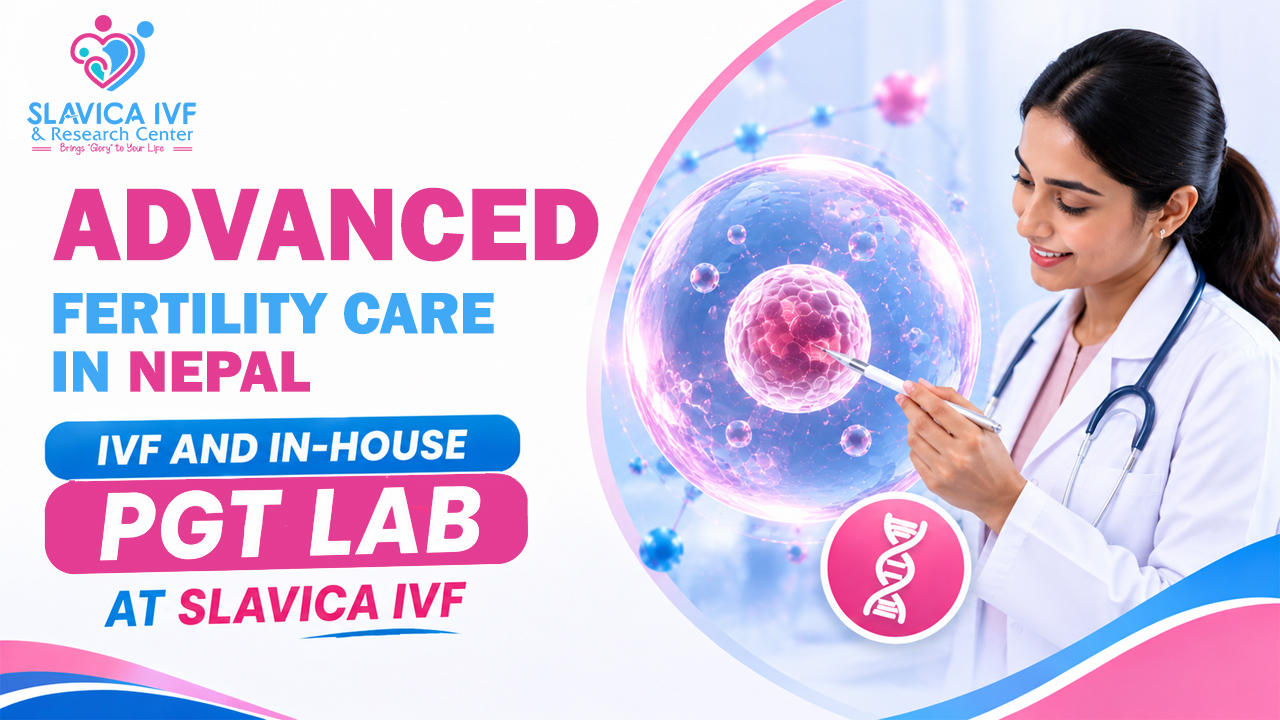
Advanced Fertility Care in Nepal: IVF and In-House PGT Lab at Slavica IVF
Fertility care in Nepal now includes far more than a single IVF procedure. At Slavica IVF and Research Center, couples and individuals can begin with a structured fertility assessment and, where medically appropriate, move toward options such as ovulation induction, IUI, IVF, ICSI, fertility preservation, and preimplantation genetic testing (PGT). This guide explains what advanced fertility care means, how IVF in Nepal works, when PGT may be useful, and what to discuss with an IVF specialist in Nepal before starting treatment.
Infertility can affect either partner, both partners, or remain unexplained after initial testing. Good care starts with identifying the likely cause, explaining realistic options, and creating a treatment plan that respects medical need, time, emotional wellbeing, and budget.
What does advanced fertility care in Nepal include?
Advanced fertility care is a coordinated approach to finding and managing difficulties with conception. It should begin with a careful history and evaluation rather than an automatic recommendation for IVF.
A complete fertility pathway may include menstrual and ovulation assessment, ultrasound monitoring, ovarian reserve testing when clinically useful, semen analysis, evaluation of the fallopian tubes or uterus, and selected genetic testing. Both partners should usually be assessed in parallel, because fertility factors can be male-related, female-related, combined, or unexplained.
Quick answers for patients
| Question | Direct answer |
| When should fertility evaluation begin? | After 12 months of regular unprotected intercourse for most women under 35; after 6 months from age 35; sooner when there are known fertility risks or the woman is over 40. |
| Is IVF always the first treatment? | No. The right option depends on the diagnosis, age, duration of infertility, previous treatment, and personal goals. |
| Does every IVF patient need PGT? | No. PGT is selected for specific clinical or genetic reasons and does not guarantee pregnancy. |
| Should male partners be tested too? | Yes. Semen evaluation is a routine part of a comprehensive fertility work-up. |
At Slavica IVF, fertility assessment may include medical history, physical evaluation, ovarian reserve testing, follicular monitoring, semen analysis, HSG when indicated, AMH testing, and selected genetic investigations. The aim is to understand the situation before choosing treatment.
When should you consult an IVF specialist in Nepal?
A fertility consultation is sensible when pregnancy has not occurred after a year of regular, unprotected intercourse. For women aged 35 or older, it is generally better not to wait beyond six months. People over 40, those with irregular or absent periods, known endometriosis, previous pelvic infection or surgery, a history of chemotherapy or radiation, recurrent pregnancy loss, or known male-factor concerns may need evaluation earlier.
Early consultation does not mean that IVF is inevitable. It gives you a clearer picture of possible next steps.
A consultation should leave you with answers to practical questions: What is the most likely diagnosis? Which tests are truly necessary? Is a lower-intensity option reasonable before IVF? What are the expected timelines, possible risks, and total costs? What happens if the first plan does not work?
How does IVF treatment in Nepal work?
In vitro fertilization, commonly called IVF, is a form of assisted reproduction in which eggs are collected from the ovaries, fertilized with sperm in a laboratory, and cultured as embryos. One embryo may then be transferred to the uterus at the appropriate time. Additional suitable embryos may be frozen for future use, depending on the treatment plan and consent process.
The IVF process, step by step
| Stage | What usually happens | Why it matters |
| 1. Consultation and tests | Review of medical history, previous reports, ultrasound, blood tests, and semen analysis. | Helps identify the likely cause and choose an appropriate protocol. |
| 2. Ovarian stimulation | Hormonal medicines encourage several follicles to develop. | Creates the opportunity to retrieve more than one egg in a cycle. |
| 3. Monitoring | Ultrasound and, when needed, blood tests track follicle growth. | Helps time medication adjustments and egg retrieval safely. |
| 4. Egg retrieval | Mature eggs are collected through a short procedure, generally with sedation. | Eggs are collected for fertilization in the laboratory. |
| 5. Fertilization and embryo culture | Eggs and sperm are combined through standard IVF or ICSI, then embryos are observed as they develop. | Gives the embryology team information for embryo planning. |
| 6. Embryo transfer or freezing | A selected embryo is transferred, or embryos are frozen for later transfer. | The transfer plan considers embryo development, uterine preparation, and patient-specific factors. |
| 7. Pregnancy test and follow-up | A blood test is performed after the advised waiting period. | Confirms whether implantation occurred and guides next care. |
IVF is not a guarantee of pregnancy. Outcomes are influenced by female age, egg and sperm factors, embryo development, uterine factors, underlying health conditions, and the reason for infertility. A reliable clinic should explain results in a way that is relevant to the patient’s age group and treatment history, rather than presenting one broad success-rate figure without context.
What is PGT, and how does it fit into IVF?
Preimplantation genetic testing, or PGT, is performed on embryos created through IVF before embryo transfer. A small number of cells are sampled from a blastocyst-stage embryo and assessed for specific chromosome or gene-related findings. PGT provides information that may help a clinician and patient decide which embryo to consider for transfer.
PGT does not “improve” an embryo, change an embryo’s genes, guarantee implantation, or guarantee a healthy baby. It is a testing tool, and its usefulness depends on the individual clinical situation. It may add cost, time, and decision-making complexity, so it should be discussed with both a fertility specialist and, where relevant, a genetics professional.
The three main types of PGT
| Type | What it assesses | When it may be considered |
| PGT-A | Chromosome number, including extra or missing chromosomes. | Selected cases, such as some patients of advanced maternal age, recurrent pregnancy loss, or repeated embryo-transfer failure. |
| PGT-M | A known single-gene condition within a family. | When one or both partners carry a known disease-causing genetic variant. |
| PGT-SR | Structural chromosome rearrangements, such as certain translocations or inversions. | When one partner has a known chromosomal rearrangement. |
The strongest reason for PGT-M or PGT-SR is a clearly identified inherited or chromosomal condition. These cases require careful pre-test work-up and counselling, because the lab must know exactly what it is trying to detect.
PGT-A is different. It may be considered in selected situations, but it is not routinely necessary for every IVF cycle. Research has not shown that universal PGT-A improves cumulative live-birth outcomes for all IVF patients. Some people may gain useful information from it; others may not benefit enough to justify the added cost and complexity. A good consultation should explain both potential benefits and limitations in the context of age, embryo number, pregnancy history, and treatment goals.
Who may benefit from PGT in Nepal?
PGT may be discussed when there is a known inherited condition in the family, a known carrier result, a chromosomal rearrangement, recurrent miscarriage, repeated implantation failure, or age-related concern about embryo chromosome status. It may also be relevant after a detailed review of previous IVF cycles.
The decision is not based on one factor alone. For example, age may raise the chance of chromosome related embryo findings, but the number and quality of embryos available also matters. If only a small number of embryos are expected, testing may change the available choices in ways that require careful discussion.
Before choosing PGT, ask:
- What specific clinical question will this test answer?
- Which type of PGT is being recommended, and why?
- Is genetic counselling required before starting?
- What happens if there are no embryos suitable for transfer?
- How will mosaic or inconclusive results be discussed?
- Is confirmatory prenatal testing still recommended after pregnancy?
Why can an in-house PGT lab matter?
Slavica IVF states that it operates an in-house PGT lab in Nepal. In practical terms, an on-site or in-house genetic testing pathway may support closer coordination between the fertility specialist, embryology team, and genetics workflow. It may also reduce dependence on sending embryo samples abroad, subject to the clinic’s specific laboratory process and quality controls.
For patients, the value is the quality of the entire pathway: embryo biopsy expertise, sample identification, validated testing methods, genetic counselling, reporting clarity, data handling, and clear discussion of limitations.
At Slavica IVF, the in-house PGT facility is positioned as part of a broader advanced fertility care pathway rather than a stand alone add on. That distinction matters. The right question is not “Should every embryo be tested?” It is “Will this test answer an important question for my situation?”
What fertility treatments are available beyond IVF?
Fertility care should be matched to the diagnosis. IVF can be highly useful, but it is only one option among several.
For ovulation-related conditions, a specialist may recommend lifestyle support, medication to induce ovulation, and timed monitoring. Intrauterine insemination (IUI) may be considered in selected cases, including some unexplained infertility or mild sperm-related situations. ICSI, a technique in which one sperm is injected into an egg, may be used when sperm factors are significant or when previous fertilization has been poor.
Some patients need surgical sperm retrieval techniques, such as TESA, PESA, or TESE, depending on the clinical situation. Others may benefit from egg freezing, sperm freezing, or embryo freezing for fertility preservation. Donor options can be explored only with appropriate medical, legal, ethical, and counselling support.
Slavica IVF lists services across this continuum, including ovulation induction, IUI, IVF, ICSI, male surgical sperm retrieval, egg freezing, semen freezing, embryo freezing, donor programs, and selected genetic testing. The appropriate choice should be made after an individual consultation.
How do you choose an IVF clinic and IVF specialist in Nepal?
Choosing a clinic is an important decision. Look beyond advertising language and ask for clear explanations.
First, confirm the qualifications and IVF specific experience of the treating specialist. Slavica IVF lists Dr. Nikita Dhakal as an MD in Obstetrics and Gynaecology and an IVF Specialist, with fellowship training in reproductive medicine. A specialist should be able to explain diagnosis, options, benefits, risks, and alternatives in language you understand.
Second, ask how the clinic reports success. Responsible reporting distinguishes between pregnancy rate, clinical pregnancy rate, live-birth rate, per embryo transfer, per cycle started, and cumulative outcome across frozen and fresh transfers. Results should be interpreted by age and diagnosis. No clinic can ethically promise an outcome.
Third, ask about laboratory and clinical systems. Useful questions include: Who performs the embryo work? Is there a dedicated embryology team? What options exist for ICSI, freezing, and PGT? How are emergencies or medication questions handled? How will I receive updates? What costs are included and excluded?
Finally, notice how you are treated. Fertility treatment can be emotionally demanding. Clear communication, respectful privacy, transparent consent, and realistic counselling are not extras; they are part of quality care.
What affects IVF outcomes?
Age is a major factor because egg quantity and chromosome status change over time. However, it is not the only factor. The cause and duration of infertility, sperm health, embryo development, uterine conditions, endometriosis, PCOS, metabolic health, smoking, previous pregnancy history, and treatment protocol can all influence results.
This is why comparing one person’s IVF experience with another’s can be misleading. The most useful discussion is personal: What is the likely prognosis in my situation? What can be changed or investigated? What is the role of additional treatment? What are the alternatives if the first cycle is unsuccessful?
A careful plan is often more valuable than a rushed plan. Maintaining a healthy routine, avoiding tobacco, managing chronic conditions, taking medicines as prescribed, and attending monitoring visits can support treatment. But lifestyle changes alone cannot correct every medical cause of infertility, so professional evaluation remains important.
Advanced fertility care at Slavica IVF and Research Center
Slavica IVF and Research Center in Sinamangal, Kathmandu, provides fertility evaluation and a range of assisted-reproduction options for patients seeking fertility care in Nepal. Its service pathway includes assessment of both female and male factors, IVF and ICSI, fertility preservation, donor options, and PGT services.
The centre’s stated in-house PGT lab can be relevant for patients whose clinical situation calls for embryo genetic testing. The decision to use PGT should follow a detailed consultation, not a generic recommendation. The most patient-centred approach is one that starts with the diagnosis, explains the available choices, and supports the patient through each decision.
For many people, the first consultation is not a commitment to IVF. It is an opportunity to move from uncertainty to a structured plan.
Frequently asked questions about fertility care in Nepal
Is IVF available in Nepal?
Yes. IVF treatment in Nepal is available through dedicated fertility centres. A complete consultation is needed to determine whether IVF is appropriate and which protocol best fits the patient’s diagnosis.
When should I see a fertility specialist in Nepal?
Consider evaluation after 12 months of trying to conceive if the woman is under 35, after 6 months if she is 35 or older, and sooner for irregular periods, known fertility risks, recurrent pregnancy loss, or age over 40.
Is PGT available in Nepal?
Yes. Slavica IVF states that it offers an in-house PGT facility for embryo genetic testing as part of selected IVF treatment plans.
Is PGT necessary for every IVF treatment?
No. PGT is not a routine requirement for every IVF patient. It is used selectively when it can answer a relevant genetic or chromosome-related clinical question.
What is the difference between IVF and ICSI?
In standard IVF, eggs and sperm are placed together in the laboratory for fertilization. In ICSI, an embryologist injects one sperm directly into an egg. ICSI may be recommended for certain sperm-related or fertilization concerns.
Can infertility be caused by male factors?
Yes. Male factors can contribute to infertility, which is why semen analysis and evaluation of both partners are important.
Does PGT guarantee a healthy pregnancy?
No. PGT can provide useful information about specific genetic or chromosome-related findings, but it does not guarantee implantation, pregnancy, or the birth of a healthy baby. Your specialist may also recommend prenatal screening or diagnostic testing after pregnancy.
What should I ask during my first IVF consultation?
Ask about the likely diagnosis, tests needed, treatment options, expected timeline, medication plan, risks, costs, embryo-freezing policy, PGT indication, and how success is measured for patients with a profile similar to yours.
Take the next step with informed fertility care
Fertility decisions can feel overwhelming, especially when advice is conflicting or time feels limited. The most constructive next step is a consultation that evaluates both partners, explains the likely cause, and outlines realistic options.
For advanced fertility care in Nepal, Slavica IVF and Research Center offers a pathway that can include assessment, IVF, ICSI, fertility preservation, and in-house PGT for selected cases. Book a consultation to discuss your medical history, treatment choices, and the questions that matter most to you.