- Sinamangal Kathmandu
Nepal -
Sun - Friday 8.00 - 18.00.
Saturday CLOSED


Secondary Infertility: Causes, Diagnosis, Treatment, and IVF in Nepal
Secondary Infertility: Causes, Diagnosis, Treatment, and IVF in Nepal
Having one child does not always make it easier to have another.
For many couples, the journey to a second pregnancy feels unexpectedly difficult. You may already know what pregnancy, childbirth, and parenting involve, so when conception does not happen again, the experience can feel confusing, isolating, and emotionally heavy. This is often called secondary infertility.
Secondary infertility happens when a person or couple is unable to get pregnant again, or carry a pregnancy to term, after having had a previous pregnancy or birth. It shares many of the same causes as primary infertility, including age-related fertility changes, ovulation issues, sperm problems, tubal damage, endometriosis, uterine conditions, and complications from prior pregnancy or surgery. Global health guidance also recognizes infertility as both a medical and public health issue, and the World Health Organization identifies infertility as either primary or secondary.
For people searching for IVF in Nepal, this topic matters because not every case of secondary infertility needs IVF immediately, but some do benefit from timely fertility evaluation and advanced treatment. The most helpful first step is not guessing. It is understanding the likely causes, getting the right tests, and discussing a personalized plan with a qualified fertility team.
At Slavica IVF and Research Center in Sinamangal, Kathmandu, patients can access advanced fertility care, including IVF and PGT, along with a broader reproductive-health approach designed to support people at different stages of their fertility journey. Slavica’s website highlights its Kathmandu-based facility, advanced reproductive technology, specialist team, and patient-focused care model.
Understanding secondary infertility
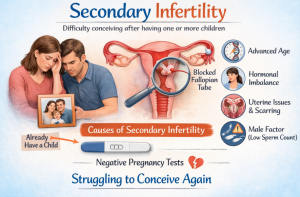
Secondary infertility means you have conceived before, but are now having difficulty becoming pregnant again or carrying a pregnancy to term. A prior successful pregnancy does not rule out future fertility problems. In fact, the causes of infertility can change over time for either partner.
This is one reason secondary infertility can be emotionally complex. Many couples think, “We did not have this problem before, so why now?” The answer is that fertility is not fixed. Egg quality changes with age, sperm health can change, menstrual cycles can become less predictable, and medical conditions may develop after a previous pregnancy. Prior surgery, endometriosis, pelvic infection, or changes in body weight can also play a role .
Secondary infertility deserves the same seriousness, evaluation, and compassion as any other fertility challenge.
How common is secondary infertility?
Secondary infertility is common enough that it should never be dismissed as unusual or “all in your head.” Cleveland Clinic notes that it is as common as primary infertility and describes it as a frequent reason people seek fertility care. The WHO also recognizes both primary and secondary infertility in its 2025 fact sheet.
For patients in Nepal, that means you are not alone if you are struggling to conceive again after already having a child. It is a medical issue worth evaluating, not something you should simply wait out indefinitely.
What causes secondary infertility?
There is no single cause. Secondary infertility may involve female factors, male factors, combined factors, or unexplained infertility. A careful fertility assessment looks at both partners rather than assuming the issue is on one side only. Mayo Clinic and Cleveland Clinic both emphasize that infertility evaluation may need to include both partners.
1. Age and egg quality
One of the most common reasons fertility changes after a first child is age. Egg quantity and egg quality decline with time, and this can affect fertilization, embryo development, and pregnancy outcomes. Even a few years between pregnancies can make a difference, especially from the mid-30s onward. Age is specifically listed among major risk factors in secondary infertility guidance.
2. Ovulation problems
If ovulation becomes irregular, pregnancy can be harder to achieve. Irregular periods, no periods, or cycle changes may suggest an ovulation problem. Broader infertility guidance identifies menstrual irregularity as an important clue that evaluation should happen sooner.
3. Fallopian tube damage
The fallopian tubes are essential for natural conception because they allow sperm and egg to meet. Tube damage can occur after pelvic infection, prior surgery, inflammation, or other pelvic conditions. Mayo Clinic identifies fallopian tube damage as a cause of secondary infertility.
4. Uterine conditions
Fibroids, adenomyosis, uterine polyps, adhesions, or scarring may interfere with implantation or pregnancy. Changes inside the uterine cavity can sometimes develop after childbirth, miscarriage management, infection, or other procedures. Uterine conditions are part of established infertility evaluation because they can affect both conception and pregnancy maintenance.
5. Endometriosis
Endometriosis can develop or worsen over time and may affect fertility through inflammation, scarring, pain, and pelvic adhesions. It is also one of the reasons people should seek evaluation earlier rather than waiting the full year in some circumstances.
6. Male factor infertility
Infertility is not only a women’s issue. Sperm count, motility, morphology, ejaculation problems, medications, illness, and other changes in male reproductive health can contribute to secondary infertility. The WHO notes that male infertility commonly relates to semen ejection problems, low or absent sperm, or abnormal sperm movement and shape.
7. Weight, lifestyle, and medical factors
Changes in body weight, smoking, alcohol use, stress, chronic disease, hormone disorders, and certain medications may affect fertility in either partner. These do not explain every case, but they are relevant pieces of the bigger picture.
8. Previous pregnancy, delivery, or surgery complications
Sometimes the cause is linked to what happened after the first pregnancy. Complications from a past pregnancy, cesarean delivery, miscarriage management, pelvic surgery, or postpartum infection may influence fertility later. These are among the causes listed in secondary infertility guidance.
9. Unexplained infertility
In some couples, tests do not identify a single clear reason. That does not mean the problem is not real. It means fertility treatment decisions need to be made based on age, history, how long you have been trying, and how you respond to earlier steps in care. Cleveland Clinic notes that some secondary infertility cases involve multiple causes or remain unexplained.
Signs that it may be time to see a fertility specialist
One of the most important questions people ask is, “How long should we try before getting help?”
General infertility guidance recommends speaking to a fertility professional if:
- you are under 35 and have been trying for 12 months
- you are 35 or older and have been trying for 6 months
- you should seek help earlier if you have irregular periods, no periods, endometriosis, previous pelvic infection, repeated miscarriages, known sperm problems, or other known fertility risks
Earlier evaluation may also be appropriate if:
- your cycles have changed significantly since your last pregnancy
- you have severe period pain
- you had pelvic or abdominal surgery
- you had a complicated prior pregnancy or postpartum infection
- you or your partner already know of a reproductive-health issue
The key message is simple: do not wait too long based only on the fact that you conceived before.
How secondary infertility is diagnosed
A good fertility workup is structured, not random. It aims to identify treatable causes and help determine whether timed intercourse, medication, IUI, IVF, or another approach makes sense.
Both partners should be evaluated
This is one of the most important trust-building points in fertility care. Evaluation should not focus only on the woman by default. Mayo Clinic states that in some cases both partners need a full infertility evaluation.
Medical history and cycle review
Your fertility specialist will usually ask:
- how long you have been trying
- how regular your cycles are
- whether ovulation is predictable
- details of prior pregnancies, miscarriages, or deliveries
- past surgeries, infections, or medical conditions
- medication and supplement use
- lifestyle factors
- male reproductive history as well
Hormone and ovulation testing
Hormonal testing may help identify whether ovulation is happening normally and whether ovarian function needs closer review. This is especially important when cycles are irregular or age-related fertility decline is a concern.
Ultrasound and uterine assessment
Ultrasound can help assess the ovaries and uterus. Depending on the case, further evaluation may be recommended to look for fibroids, adenomyosis, uterine cavity issues, or ovarian changes.
Tubal testing
If tubal damage is suspected, testing may be needed to check whether the fallopian tubes are open. Tubal status is especially important because severe tubal damage often changes the treatment pathway and can make IVF more relevant.
Semen analysis
A semen test is a standard part of fertility evaluation and should not be delayed. Male factor infertility may arise even after a previous successful pregnancy, so it is important not to assume sperm health is unchanged.
Additional tests when needed
Depending on your history, your specialist may recommend more targeted testing. This may include uterine cavity assessment, ovarian reserve testing, or selected genetic evaluation in appropriate cases.
Treatment options for secondary infertility in Nepal
Treatment depends on the cause. This is where many articles online become too simplistic. Not every couple with secondary infertility needs IVF first. The best plan depends on age, diagnosis, duration of trying, and previous treatment history.
General infertility treatment pathways commonly include medication, surgery for selected conditions, and assisted conception such as IUI or IVF. NHS guidance summarizes these as the three main broad categories of infertility treatment.
Lifestyle and cycle optimization
For some couples, fertility improves when timing, ovulation monitoring, weight management, and general health issues are addressed. This step matters most when there is no severe structural or male-factor issue and time is still on your side.
Medication for ovulation disorders
If ovulation is irregular or absent, medication may help support ovulation. This may be suitable before IVF in appropriately selected patients. Treatment choice should always follow diagnosis, not guesswork.
Treatment of underlying conditions
Some cases require treatment of the underlying issue first, such as endometriosis-related problems, uterine abnormalities, or male-factor causes. Surgical treatment may be part of the pathway in selected cases.
IUI
IUI may be considered in selected situations, especially when ovulation is occurring or can be supported, tubes are open, and sperm factors are not severe. It is generally less invasive than IVF, but it is not the right choice for everyone.
IVF
IVF becomes especially relevant when there is tubal damage, more significant age-related decline, severe male factor infertility, failure of simpler treatments, repeated unexplained infertility over time, or selected complex cases. IVF is an assisted reproductive technology in which eggs and sperm are brought together in the lab, and embryos are then transferred to the uterus. IVF is a recognized fertility treatment option within major clinical guidance.
For readers searching specifically for IVF in Nepal, the important point is this: IVF should be recommended because it fits your diagnosis, not just because it is the best-known fertility treatment.
When PGT may be considered
PGT is not required for every IVF cycle, but it may be discussed in selected situations, such as known genetic concerns or when embryo genetic screening is clinically relevant to the treatment plan. Slavica’s service page describes PGT as screening embryos for genetic abnormalities before transfer.
When IVF may be the right option
A lot of people searching for an ivf clinic in nepal or ivf center in nepal are really asking whether IVF is the right next step for them. IVF may be more appropriate when:
1. The tubes are blocked or severely damaged
If sperm and egg cannot meet naturally, IVF may bypass that obstacle.
2. Age is affecting fertility
If age-related decline in ovarian reserve or egg quality is a major factor, the window for simpler treatments may be narrower.
3. There is significant male factor infertility
Sperm-related problems can make IVF, sometimes with related advanced lab support, more appropriate than lower-complexity treatments. WHO and Mayo both note that sperm issues are central in infertility evaluation.
4. Endometriosis or pelvic disease is affecting conception
For some couples, endometriosis or pelvic scarring changes the treatment plan significantly.
5. Previous treatments have not worked
When timed intercourse, medication, or IUI have not led to pregnancy, IVF may offer the next step in care.
6. Selected recurrent loss or genetic concerns
In some situations, IVF with additional testing such as PGT may be discussed, depending on medical history and specialist recommendation.
What to expect from an IVF clinic in Nepal
When choosing an ivf center in Nepal, patients should look beyond marketing language. A good clinic experience should include clear communication, careful diagnosis, realistic counseling, and appropriate lab and clinical support.
Important things to look for include:
- an experienced fertility team
- individualized treatment planning
- access to advanced reproductive technology
- clear explanation of tests and treatment steps
- compassionate support during a stressful process
- transparent discussion of when IVF is needed and when it may not be
These trust signals matter because infertility care is not only technical. It is also emotional, time-sensitive, and highly personal.
Why choose Slavica IVF and Research Center
For readers exploring infertility treatment in Nepal, Slavica IVF and Research Center offers several trust-building features on its current website.
Slavica states that it is located in Sinamangal, Kathmandu, making it accessible for patients looking for fertility care in the capital. The clinic highlights advanced reproductive technology, a specialist team, and comprehensive reproductive services. Its site also describes a state-of-the-art facility and notes the availability of advanced services including IVF and PGT. The clinic’s published contact details include 9822799666.
That combination of location, technology, and specialist focus is useful for couples who need a structured fertility workup rather than generic advice alone.
You can naturally mention the clinic within the article like this:
- Learn more about the clinic’s fertility services on the Slavica IVF homepage.
- For more about the center’s approach and background, visit About Us.
Coping with the emotional side of secondary infertility
Secondary infertility is often misunderstood by others. Because you already have a child, people may assume the problem is minor, temporary, or less painful. In reality, many couples experience grief, guilt, pressure, and emotional exhaustion.
Mayo Clinic notes that infertility can be emotionally heavy enough that professional support may help during diagnosis or treatment.
A healthier mindset is:
- acknowledge that your struggle is real
- avoid comparing your current fertility to your past pregnancy
- seek answers early rather than blaming yourself
- involve your partner in evaluation and decision-making
- choose a clinic that communicates clearly and compassionately
Hope matters in fertility care, but it should be grounded in proper diagnosis and an individualized plan.
Secondary infertility and IVF in Nepal: a practical next-step framework
If you are trying for another pregnancy and feeling unsure what to do next, this framework can help:
Step 1: Track the basics
Know how long you have been trying, whether your cycles are regular, and whether there are any obvious changes since your previous pregnancy.
Step 2: Don’t assume it is only one partner
Secondary infertility can involve female factors, male factors, both, or unexplained causes. A couple-based evaluation is more useful than one-sided assumptions.
Step 3: Seek help on time
Under 35: seek evaluation after 12 months.
35 or older: seek evaluation after 6 months.
Get help sooner if you have irregular periods, severe pain, endometriosis, repeated miscarriage, or known reproductive-health issues.
Step 4: Follow the diagnosis
Treatment should match the cause. Some people may need cycle support or medication. Others may benefit from IUI. Some will be better candidates for IVF in Nepal based on their results.
Step 5: Choose a clinic that offers both expertise and empathy
Fertility care works best when medical accuracy and compassionate communication come together.
Conclusion
Secondary infertility can feel especially difficult because it often arrives with surprise. You may have conceived before, but fertility can change with age, health, reproductive conditions, sperm factors, and life events. The good news is that the problem can be evaluated, and treatment options do exist.
The most important step is not self-blame. It is getting the right guidance.
For couples looking for ivf in nepal, ivf clinic in nepal, ivf center in nepal, or infertility treatment in nepal, a thoughtful fertility assessment can clarify whether IVF is the right next step or whether another treatment path may be more appropriate first.
If you would like to speak with a fertility team in Kathmandu, contact Slavica IVF and Research Center at 9822799666 to discuss your concerns and the next steps in your fertility journey. (Slavica)
FAQ Section
1. What is secondary infertility?
Secondary infertility means difficulty getting pregnant again or carrying a pregnancy to term after a previous pregnancy or birth. It is medically recognized and can affect either or both partners.
2. Can you have infertility even if you already have one child?
Yes. A previous pregnancy does not guarantee future fertility. Age, ovulation changes, sperm issues, tubal damage, uterine conditions, endometriosis, surgery, and health changes can all contribute later.
3. When should I see a fertility doctor for secondary infertility?
Generally, after 12 months of trying if under 35, or after 6 months if 35 or older. You may need earlier evaluation if you have irregular periods, endometriosis, repeated miscarriage, or known fertility concerns.
4. Does secondary infertility always need IVF?
No. Some cases may respond to lifestyle changes, ovulation treatment, or other targeted care. IVF is one option and is usually recommended when it fits the diagnosis, such as tubal problems, significant male factor infertility, age-related decline, or failed previous treatments.
5. Should both partners be tested?
Yes. Fertility evaluation often needs to include both partners, because male factors can contribute significantly to infertility.
6. What tests are usually done for secondary infertility?
Common evaluation steps may include history-taking, cycle review, hormone or ovulation assessment, ultrasound, uterine or tubal testing, and semen analysis. The exact plan depends on your history.
7. What is PGT in IVF treatment?
PGT stands for preimplantation genetic testing. Slavica describes it as screening embryos for genetic abnormalities before transfer in selected IVF cases .
8. Where can I find an IVF clinic in Nepal for secondary infertility?
Patients looking for fertility care in Kathmandu can explore Slavica IVF and Research Center, which highlights IVF, PGT, advanced reproductive technology, and specialist-led fertility services on its website.